About Universal Modder Guides
An open-source documentation initiative providing transparent, reproducible guides for modding legally owned single-player PC games with autonomous AI coding agents.
Our Mission & Origin
Universal Modder Guides was created to solve a persistent challenge for PC gamers, developers, and technical creators. The rise of autonomous AI coding assistants—such as Claude Code, OpenAI Codex, Cursor, Gemini CLI, and VS Code extensions—has revolutionized how code is analyzed and developed. In game modding, tasks that historically demanded deep assembly reverse engineering, custom memory injection tools, and tedious asset manipulation can now be accelerated through structured agent workflows.
However, running autonomous coding agents against local PC games introduces significant practical complexity. Enthusiasts discovering Universal Modder on platforms like X, Reddit, and YouTube frequently run into vague setup instructions, broken environment variables, missing prerequisite packages, and confusing tool pricing models. Many online discussions fail to clarify where plugins run, how local command-line tools interface with game files, or how AI model token costs differ from generative asset services like fal.ai.
Universal Modder Guides was established as a dedicated, open-source technical resource to deliver clear, repeatable, and step-by-step documentation for every supported AI agent environment. Our goal is to empower players who legally own single-player PC games to safely customize mechanics, tweak character attributes, create custom weapon behaviors, and generate original 2D or 3D assets on their own machines without technical confusion.
How We Review Our Documentation
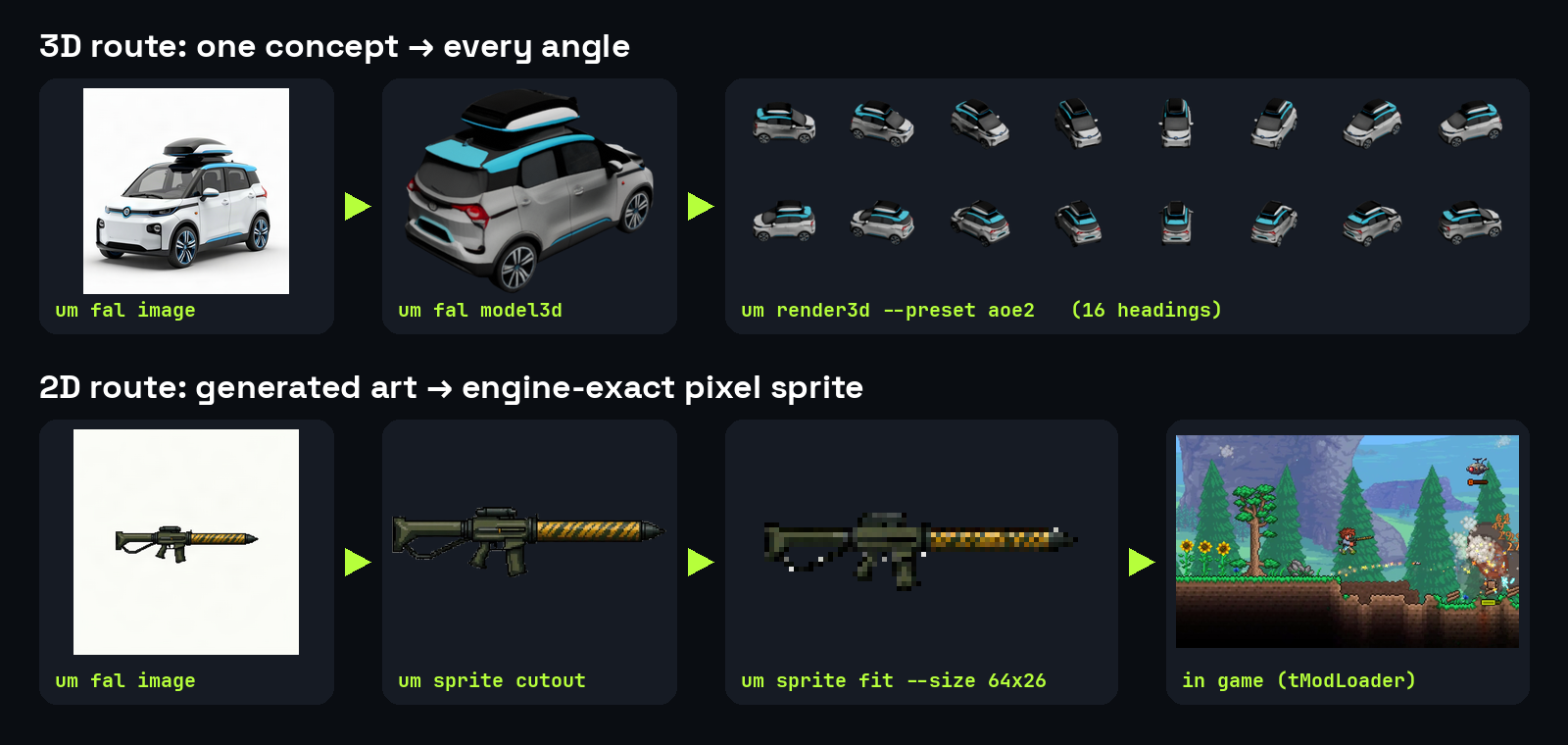
Figure 1.0: Upstream asset pipeline — 3D concept to 16 AoE2 headings; 2D art to a 64x26 Terraria sprite.
These guides are based on the upstream repository snapshot and saved setup guide in our source materials. We review documented commands and configuration files; the installation commands have not been tested in a live installation for these pages.
Our documentation review covers:
- Requirements & Installation Sources: We check requirements against the upstream README: Python 3.10+ and ffmpeg, recommended uv, and Blender for 3D-to-sprite rendering. Windows winget commands are checked against the saved setup guide; this is a source comparison, not a Windows installation test.
- Client Configuration: We compare each client's setup instructions with the repository README, AGENTS.md, plugin manifests, and client-specific MCP configuration. Upstream worked examples describe their own environments and results; they are not installation tests performed by this guide site.
- Costs & Usage Boundaries: We distinguish the free MIT-licensed toolkit from AI assistant subscriptions or billing and paid fal asset generation. We describe the costs stated in the source materials; we do not claim to have benchmarked generation prices.
Each tutorial records its source review date and links to the materials used. Any future live test should state its environment, versions, and observed results explicitly; a source review date does not imply that such a test took place.
Strict Single-Player & Ethical Boundaries
Game modding has long been an incredible driver of community creativity, software engineering education, and game longevity. However, modding must never come at the expense of online multiplayer integrity or the security of game developers. Universal Modder Guides operates under a firm, non-negotiable ethical standard.
Single-Player Environments Only: All workflows, scripts, and AI prompts featured on this site are designed exclusively for legally purchased single-player games, private dedicated servers, and offline environments where modifications do not impact other players.
Zero Tolerance for Anti-Cheat Tampering: We do not provide instructions, tools, or techniques to circumvent multiplayer anti-cheat software (such as BattlEye, Easy Anti-Cheat, Ricochet, or Valve Anti-Cheat). Any request to bypass online anti-tamper mechanisms or build competitive online exploits is strictly rejected by our project policy.
Respect for Intellectual Property: We do not host, distribute, or facilitate the download of pirated game binaries, cracked software, or copyrighted assets. Users must hold legitimate licenses for games they inspect, and all activities must respect the fair use principles and End User License Agreements of the respective publishers.
Open-Source Attribution & Contact Information
Universal Modder Guides is proud to be part of the broader open-source software ecosystem. The underlying universal-modder toolkit was developed by Rehan and is licensed under the permissive MIT License. Our documentation exists to support, explain, and democratize access to these cutting-edge agent tools for enthusiasts around the world.
We actively welcome community feedback, technical corrections, and guide contributions. If you discover an outdated CLI parameter, observe an undocumented edge case on specific hardware, or want to suggest tutorials for new game engines, please reach out to our team:
Official Editorial Contact: [email protected]
Upstream Project Repository: github.com/rehan-remade/universal-modder
License: MIT Open-Source Community Documentation
Whether you are an experienced software developer automating game asset generation or a PC gamer configuring your first AI assistant, Universal Modder Guides is dedicated to making your local modding journey accessible, dependable, and secure.